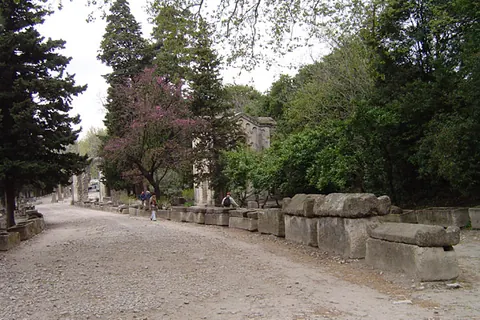
The Alyscamps is a large Roman necropolis, which is a short distance outside the walls of the old town of Arles, France. It was one of the most famous necropolises of the ancient world. The name comes from the Provençal Occitan word Aliscamps, which comes from the Latin Elisii Campi. They were famous in the Middle Ages and are referred to by Ariosto in Orlando Furioso and by Dante in the Inferno.
Roman cities traditionally forbade burials within the city limits. It was therefore common for the roads immediately outside a city to be lined with tombs and mausoleums; the Appian Way outside Rome provides a good example. The Alyscamps was Arles’ main burial ground for nearly 1,500 years. It was the final segment of the Aurelian Way leading up to the city gates and was used as a burial ground for well-off citizens, whose memorials ranged from simple sarcophagi to elaborate monuments. In 1981, the Alyscamps was classified a UNESCO World Heritage Site, as part of the Arles, Roman and Romanesque Monuments group.
Places in the district
- Alyscamps0 m
- LUMA Arles220 m
- Abbey of St Caesarius680 m
- Roman Theatre of Arles800 m
- Arles Amphitheatre850 m
- Arles, Roman and Romanesque Monuments860 m
- Church of St. Trophime920 m
- Obélisque d’Arles930 m
Sources
Text: introduction of the Wikipedia article Alyscamps, under the CC BY-SA 4.0 licence (authors: article history). Facts: Wikidata (CC0). Coordinates: Wikidata, map background © OpenStreetMap contributors.